This Is Your Life, This Is Your Story
- Rebecca Agostino
- Jun 3
- 3 min read

There's a lot of emphasis in career pathway work on planning. If only we can pair students with the right sequence of courses, design the right pathway, map out the right trajectory, they'll be able to successfully launch into a linear career — right?
Students have to do things to know things about themselves. The most we can really offer them is the structure and support to try out the next step and the skills to make meaning from it when they do. That means helping them discover not just what they're good at, but what they don't like. That second part is equally valuable, and often completely absent from how we talk about career development.
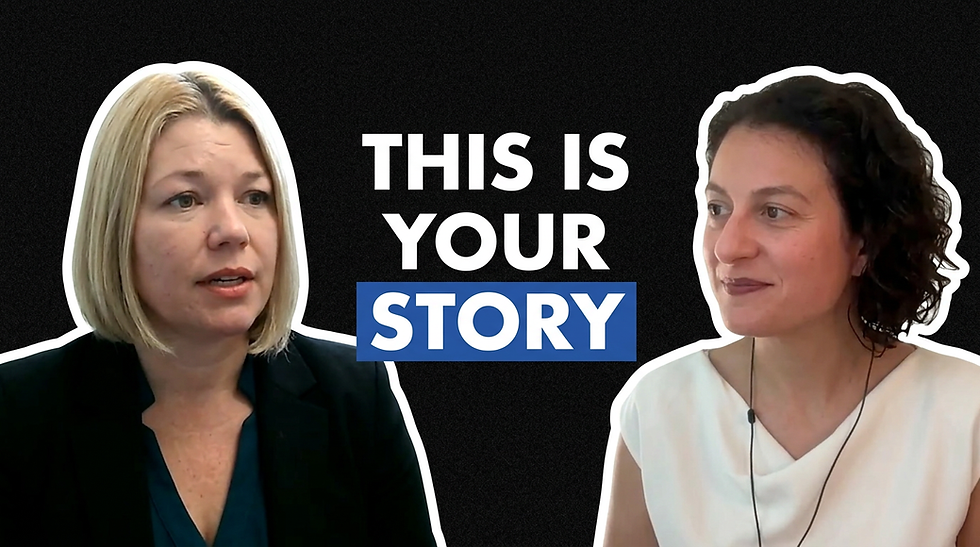
This week I spoke with Dr. J. Heather Handler, the 2025 CTE Maryland Administrator of the Year and author of the forthcoming The Educator's Guide to Youth Apprenticeships: Blueprinting Tomorrow's Workforce in Today's High Schools. She has spent her career navigating personal change — military service, school guidance, program-building — and helping students do the same. She is one of the most successful and thoughtful CTE leaders I've had the pleasure of meeting.
What struck me most about our conversation was her understanding of career navigation as a journey with many legs, not a single destination. The role of CTE, in her view, isn't to match a student to an experience. It's to send them out into the world with enough confidence and skill to find their own way — from interest to first job to career and beyond.
We started, as we always do, with her own story.
Dr. Handler's first job was shoveling snow off a tennis bubble at a ski resort in Stowe, Vermont. She was sixteen, she was strong, and she went in with a plan: work this temporary gig into something permanent. When the job was done, her supervisors told her that every other person they'd ever hired for that task had taken breaks constantly, and that she had worked so hard they were even a little worried about her. They hired her for an internal role and invested in training her as a lifeguard.
She credits her mother. "Work it like it's the last job you're ever gonna have," her mom told her. "Always leave a place where they want more."
Employers are, as a general rule, deeply risk-averse: they want someone else to have tested out a hire before they take a chance. It's scary to make the first bet on a young person, especially if resources are constrained, and in this environment, young people face a real catch-22: you need experience to get experience.
I worry that in our rush to place students into polished, corporate-facing opportunities, we've lost sight of something Handler understood instinctively at sixteen: that hard work, in any context, is legible.
Dr. Handler has made a few pivots since those snow-shoveling days — lifeguarding, then search and rescue in the Navy, then a teaching career that eventually led her to build one of the most robust youth apprenticeship programs in the country. She told me that when she looks at her students, she often sees herself, or her younger brother — and remembers exactly how uncertain and searching that time of life feels. That recognition, she says, is what motivates people to help.
One of my favorite anecdotes from our conversation was a story about a student who joined the lineworker program she launched in Cecil County, Maryland — a $500,000 grant-funded initiative built in partnership with one of only two lineman schools on the East Coast. The student thought he was ready and comfortable with heights. But a ladder in your backyard is nothing like ninety feet in the air, clipped into a wooden pole, trusting your gear. Three weeks in, he froze and realized he couldn't do it.
With support from Handler's team, he was able to sit with that experience and ask a different question: what did he actually like about the work? The answer was the wires, the voltage, the problem-solving. While not the right fit for linework, he had the aptitude for electrical, and the flexibility to make the switch.
Handler is clear-eyed about the fact that most students don't have a team like hers standing by to help them make that pivot. So I asked what she'd say to a student navigating without that kind of support. Her answer was direct: find your local workforce network, your chamber of commerce, your community college. Start with an email and ask for help. We need to prepare students for the twists and turns of a career — and agency exercised early and often, not perfection in planning, is what compounds into one.
"This is your life. This is your story."


Comments